Wednesday, June 25, 2014

Ariyanacci - Part II: A Mother At Last


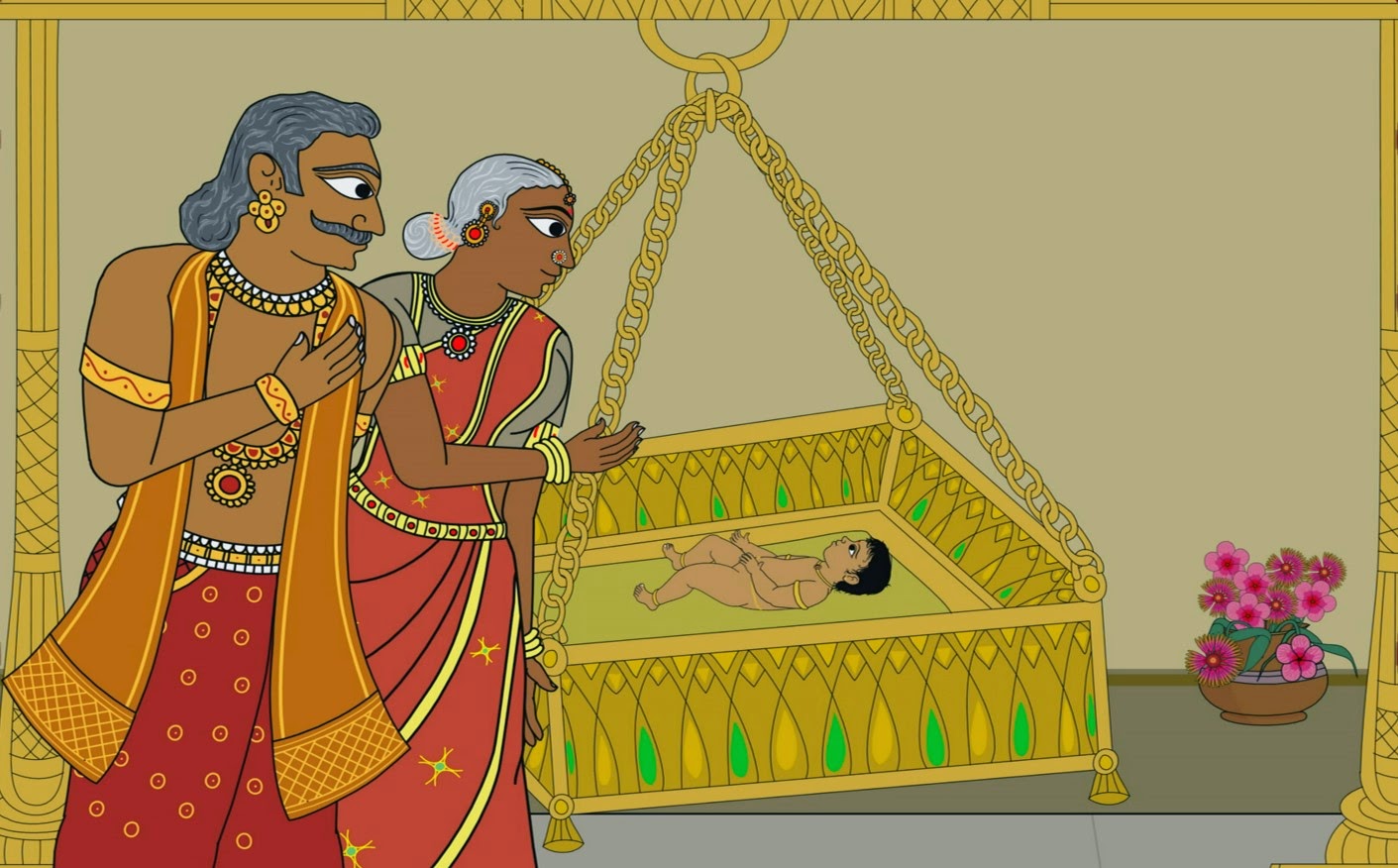
One day Kolatta finds a baby boy under a pile of rocks in his back field. He brings the infant home in his arms and shows it to Ariyanacci. At first this is a big surprise and she is not sure what to do!

Ariyanacci sits on her porch wondering how she will nurse this little boy.

At that very moment, Lord Vishnu appears. He tells Ariyanacci to set the baby down and then come stand beside him.

Next Vishnu magically creates seven saris that stretch through the air. They hang weightlessly between Ariyanacci and her little son.

Vishnu then fills Ariyanacci’s breasts with milk and lets the first drops fly through the air to the baby’s mouth. She knows now... that she will be able to feed her new child.

The couple are thrilled and very happy to adopt this beautiful little boy. They have wanted a child for so long!

Ariyanacci raises her little son with love and tenderness.

Soon the couple decide to take the child to the temple where they will give it a name.

Lord Vishnu visits once again. He names the little boy as he lies in the lap of the family goddess Celatta. She is a special female (a Sakti) who looks after the beautiful lands of Ponnivala.

As the boy, now named Kunnutaiya, grows Ariyanacci tries to give him lots of fun adventures.

As Kunnutaiya grows he imagines himself as a fine horseback rider running at full gallop across the beautiful lands that lie all around him.

But Ariyanacci knows she and Kolatta are growing old. She begins to worry about the future for her young son.

She dreams of a long life but knows there may not be much time left.

Ariyanacci hugs her young son and tries to enjoy their remaining time together.

[<==Back to Part 1]

Tuesday, June 24, 2014

Kolatta - Part II: The Family’s First Big Political Challenge


There are already people in Ponnivala who do not welcome these newcomers.

The artisans hear that rights to farm the lands they live on are about to be granted to new comers. Angry, they complain to the Chola king.

As a result there is a major standoff. Eventually it is decided that a great public contest will decide the matter.

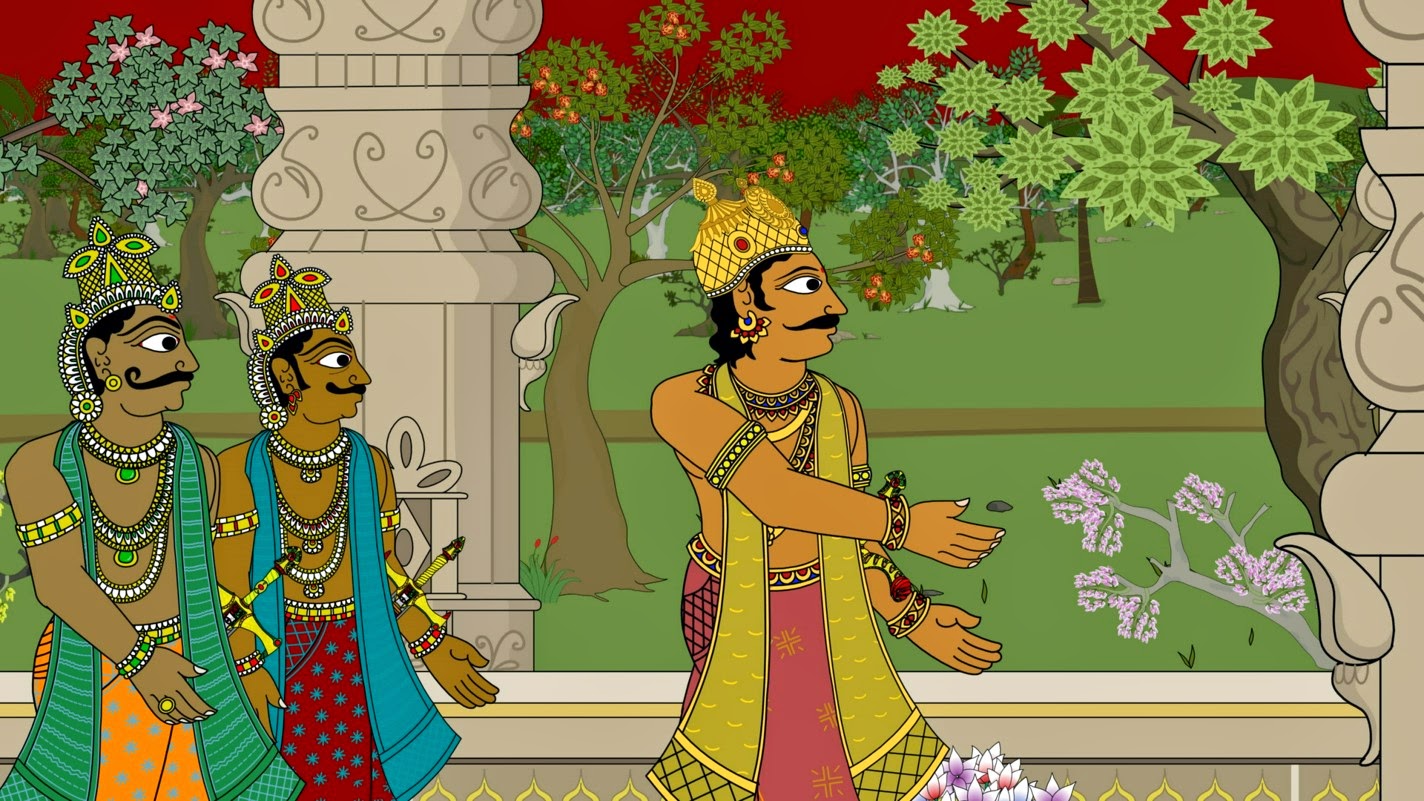
The two antagonistic groups gather for the big event.

Lord Vishnu then places Kolatta under the earth at a key spot very near the river. This waterway is very important to Ponnivala. Choosing this spot helps to identify Kolatta with the land.

Then Kolatta is made to rise up gradually while the artisans try to behead him by throwing swords.

The artisans try their best but Kolatta emerges unscathed.

Lord Vishnu, standing between the Chola king and other important dignitaries, declares Kolatta the winner.

The outcome is a social contract. The farmers will pay the artisans for their work with fixed amounts of local produce. Social life in Ponnivala will be governed by rules.

The local artisans agree to this new rule of law, though underneath resentment between the two groups continues to simmer.

Meanwhile, the land is divided between brothers. Kolatta gets Ponnivala, with better soil. His 8 siblings receive neighbouring Tangavala. This creates a key source of future bitterness.

The trees are cut and serious farming starts. No thought is given to the hunter-tribesmen who are watching all this forest destruction from the nearby hills. Where will all the wild animals hide now?

Kolatta now works extremely hard to open up his new farmland. He even digs wells as a way of keeping his fine fields moist.

As a result, the land known as Ponnivala begins to flourish.


Links To Known History:
  • Ponnivala`s epic story continues to match, in a broad way, the known history of Tamilnadu. Many disputes between artisans and farmers are recorded in actual inscriptional records dated between the 10th and 12th centuries from this area. These were generally described as ”left-hand” versus “right-hand” confrontations... with the right hand alliance being that of the farmers.
The Ponnivala artisans’ problem also links to certain geographic and economic facts. This area lies on either side of a very ancient and key trade route used from as early as 2,000 B.C. The caravans that regularly passed through linked the Kerala coast with several important commercial centres, including those of Karur, Uraiyur and Madurai. The artisans living in Ponnivala were most likely merchant-traders who had a strong interest in interfacing with the goods-trains that regularly moved through their region.


KOLATTA - Pt. I: The Legend’s Clan Ancestor, Grandfather and Pioneer


Kolatta arrives on earth as an adult – with 8 brothers - via a lightning bolt sent by the goddess. He will become the first clansman, a leader in a virgin land.    

The nine brothers quickly receive a divine order from the great goddess herself:

They are to open up the virgin forest lands seen all round them

And begin ploughing the good earth.

The goddess also creates women to become the brothers’ wives. Kolatta marries one of these women.

The nine pioneers build a humble home

But after all this hard work there is an unexpected new problem: a period of severe drought.

All the brothers are distressed by this unexpected hardship.

Their families have to find a way to survive.

So they decide to send the eldest couple to investigate a neighbouring area where the lands are rules by a powerful Chola king.  

Kolatta and his wife explain their hardship to the king. He grants them both work in his prosperous fields.

Kolatta and his wife work hard and the king appreciates their contribution.

Soon the other eight brothers arrive and find similar work. All benefit from Kolatta’s good name.

Pleased with his kingdom’s prosperity the Chola rewards Kolatta and his brothers with a land grant.

They are to be given rights to plough an area known as Ponnivala. But trouble lies ahead.
The Ponnivala story now begins to align itself with actual historical records from this area, the Tamil-speaking region known as Kongu nadu.
  • In the 10th Century A.D. a line of powerful Chola kings were gradually expanding into the Kongu area. Their emissaries slowly moved up the Kaveri river, tracing key local trade routes as they sought increasing economic benefits.
  • The Chola empire was also building temples and gradually expanding their influential name.
  • These kings needed farmers who would be their allies. Loyal families could extend the Chola’s power. Wealthy local landlords were also expected to deliver periodic tribute payments. These payments were used to symbolize the giver’s willing submission to the Chola’s centralized monarchy.


Monday, June 23, 2014

Ariyanacci Part I: Ponnivala’s First Lady

We do not know much about Ariyanacci’s early life. But we do know that she was created by the goddess Parvati. She was asked to marry the pioneer farmer Kolatta and help start family life on earth.

Kolatta placed a flower garland on Ariyanacci’s neck to make their marriage official. They did not have enough wealth for a fancy ceremony.

But soon the couple soon had some bad luck. There was a terrible drought.

All the trees and grasses around their little house dried up!

All over the land there was nothing but hunger and misery.

So Ariyanacci and her husband decided to move. They walked until they finally found a better area near by.

A rich king lived there. He had a very fine palace and was famous throughout the area. He was called a “Chola,” which was the name of his family line.

Ariyanacci and her husband asked the king for work. He granted this wish and agreed to pay the two together wages of 1 ½ workers. This was a fair and respectful arrangement according to local custom.

Ariyanacci helped with the king’s assigned work. She was kept busy with the planting of young rice plants in the Chola’s fine fields.

As a result of Ariyanacci and Kolatta’s hard work the Chola’s kingdom prospered even more than before.

All the animals in the area were fat and happy.

The Chola king was so happy with the young couple’s work that he decided to grant them land in an remote area known as Ponnivala. He asked them to go there as pioneers and start farming.  

This is how Kolatta and Ariyanacci came to settle in beautiful Ponnivala, a land named after the golden (Ponni) river that ran through it.

The Chola king even came to Ponnivala and helped the couple to settle in and to establish their social rights there as immigrants.

Kolatta soon began to plough the lovely lands of Ponnivala. Ariyanacci followed behind, sowing seeds in each of their new fields.

But Arriyanacci soon became sad. She and Kolatta were now getting old. There were no young children in the palace to carry forward their new farming traditions. What could they do?